
🧠 How to Apply Behavioural Science for Better Sports Experiences
How to use psychology to create better experiences, stronger brands and more valuable relationships.
Sport is stranger than you think
Teams wearing red are more likely to win.
Teams wearing black receive more penalties.
Supporters celebrate victories by saying "we won", yet defeats somehow become "they lost."
Millions of people wear lucky shirts, sit in the same seat, refuse to wash a favourite jersey or insist on watching with the same group of friends - despite knowing none of these rituals can possibly influence the result.
Each of these observations offers a glimpse into the psychology of sport.
Sport provides one of the richest environments for observing human behaviour because it amplifies many of the forces that shape our decisions every day. Identity becomes tribal. Uncertainty becomes exciting. Shared attention becomes collective emotion. Fleeting moments become lifelong memories.
Those psychological forces have important commercial implications.
They help explain why some sporting organisations create lifelong supporters, iconic brands and enduring communities, while others struggle to build lasting engagement.
At Capuchin Behavioural Science, we combine psychology and data to understand why people behave as they do - and apply those insights to deliver measurable commercial results.
The experience begins before kick-off - and rarely ends there
A Formula One race lasts around two hours.
The psychological experience can last all week.
Before race day come predictions, qualifying, social media, podcasts, fantasy leagues, behind-the-scenes documentaries and endless debate. Afterwards, fans replay highlights, analyse strategy, follow drivers online and begin anticipating the next race.
The same pattern appears across almost every sport.
Marathon runners spend months training for a single morning. Cricket supporters follow overseas tours. Tennis fans become immersed in the stories that unfold across Wimbledon fortnight. Cycling enthusiasts build their summers around the Grand Tours.
Behavioural science helps explain why these experiences feel so compelling.
Anticipation is rewarding in its own right. Uncertainty captures attention because our brains are constantly trying to predict what happens next. Shared experiences amplify emotion, while memory gives disproportionate weight to moments of surprise and the way experiences end.
The event is one chapter in a much longer story.
Some sporting experiences continue far beyond the competition itself.
Lewis Hamilton's influence extends well beyond Formula One. Partnerships with brands such as IWC, Tommy Hilfiger and Lululemon reach audiences who may never watch every Grand Prix. Michael Jordan transformed trainers into cultural icons. Millions of people wear New York Yankees caps without following baseball.
The psychological associations created through sport travel remarkably well. They extend into fashion, luxury, technology, travel and lifestyle brands, often reaching people who rarely watch the sport itself.
Why do people care so much?
Ask ten people why they love sport and you'll probably hear ten different answers.
Some describe growing up watching matches with their parents.
Others love analysing tactics or technique.
Some enjoy the thrill of uncertainty.
Others value having something to escape into after a difficult week.
Behavioural science helps explain why every one of those answers makes sense.
Research shows that fandom fulfils a surprisingly broad range of psychological needs, including belonging, self-esteem, companionship, curiosity, emotional escape, mastery and meaning.
In our own work, we often think about these motivations in more human terms.
"I want to sink into a bubble."
"Life isn't challenging enough."
"I want to be the better brother."
Each represents a different reason for engaging with exactly the same sporting event.
Sports organisations that recognise these motivations can create far more relevant experiences, communications and products.
Two supporters sitting side by side may share very little beyond the ticket they purchased.
Behaviour hides in plain sight
One of the joys of behavioural science is discovering that seemingly irrational behaviour often has perfectly sensible psychological explanations.
Supporters instinctively say "we won" after victory, yet "they lost" after defeat because success becomes incorporated into identity, while failure is psychologically distanced.
Rituals - from lucky socks to pre-match routines and athletes arranging water bottles in exactly the same position - help create a sense of control in environments dominated by uncertainty.
The extraordinary success of Drive to Survive owes as much to psychology as it does to motorsport. Rivalries, personalities and relationships transformed drivers into characters audiences felt they knew personally. Psychologists call these parasocial relationships - one-sided emotional connections that can feel remarkably real.
Luxury brands offer another interesting comparison. Both luxury and sport create symbols of identity, status, belonging and aspiration. Supporting a team and wearing a prestigious watch satisfy different needs on the surface, yet the underlying psychology often overlaps.
Understanding the psychology behind sport adds another layer of fascination. It reveals how remarkably the human mind creates attachment, meaning and belief.
Turning psychology into commercial results
Every commercial objective in sport depends on behaviour.
Choosing to attend.
Renewing a membership.
Taking part for the first time.
Buying merchandise.
Following an athlete.
Sharing content.
Downloading an app.
Supporting a sponsor.
Behavioural science helps organisations identify the motivations and barriers behind each of those decisions.
That understanding can strengthen participation programmes, fan engagement, sponsorship activation, hospitality, customer journeys, digital experiences and loyalty by designing around the way people really think and behave.
At Capuchin, we've already applied behavioural science to deliver measurable commercial results across multiple sectors, including increasing player value by 15%, generating a 12% sales uplift worth £18 million, doubling conversion rates, increasing app downloads by 4.5x and acquiring more than 4,000 high-value customers through psychologically informed interventions.
Sport has become extraordinarily good at analysing athletes.
Behavioural science gives you the same scientific understanding of your audiences.
Don't Build Audiences. Build Believers.
Competition brings people together.
Psychology explains why they keep coming back.
Sport creates identities.
Communities.
Traditions.
Stories.
Memories.
Organisations that understand those psychological forces are better placed to create experiences people remember, brands people care about and relationships that last far beyond the event itself.
Behavioural science provides a practical framework for understanding those forces - and applying them in measurable ways.
Want the full story?
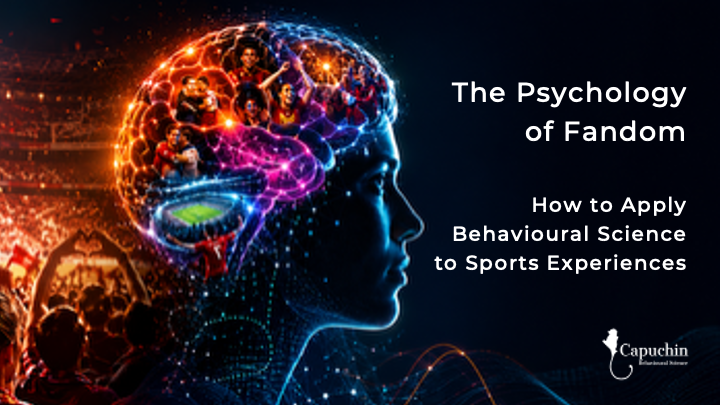
This article touches on just a few of the ideas explored in our presentation, The Psychology of Fandom: How to Apply Behavioural Science to Sports Experiences.
If you'd like a copy of the presentation, we'd be delighted to share it.
And if you have challenges around fan engagement, participation, sponsorship, digital experiences or commercial growth, we'd love to hear about them.